
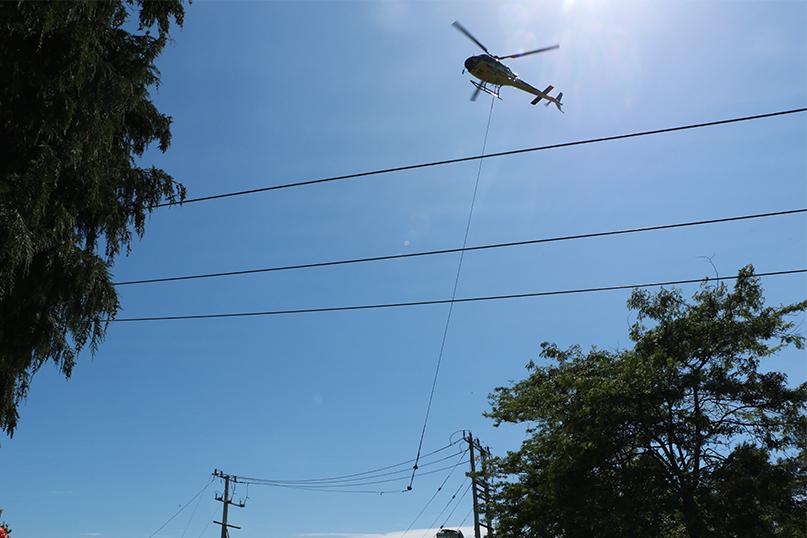
Six power lines found a new home this week, after they were relocated to prepare for the construction of Hamilton’s newest bridge.
WEL Network (who own and manage the lines) moved the 11kV and 33kV overhead lines across the Waikato River via helicopter to make way for the bridge, which will connect Hamilton’s existing transport network to the new neighbourhood of Peacocke in the south of the city.
Hamilton City Council’s Strategic Development Manager Andrew Parsons said the decision to use a helicopter to string each of the new powerlines across the Waikato River was made by WEL Networks as it is a cost-effective option for this type and scale of work. The work was budgeted for in the city’s 2018-28 10-Year Plan.
The power lines will eventually be laid into the new bridge via cable once construction is completed in 2023.
Mr Parsons said this was an exciting moment for Hamilton as we get closer to breaking ground on the new bridge and surrounding transport network.
“Earlier this year the Council approved the basic structural design of the bridge and its key design principles. The bridge is planned to feature a single Y-shaped pillar on the south bank of the river, supporting a flat deck bridge spanning more than 200 metres.
“The next steps in the project are to develop the detailed design and award a construction contract. We’re aiming to start construction by the end of 2020.”
Work is already underway on the Ring Road – Wairere Dr extension which will provide a link to the new bridge and complete the city’s Ring Road network.
Peacocke is being built with the support of $290.4M from the Government’s Housing Infrastructure Fund, made up of a $180.3M 10-year interest-free loan and $110.1M of Waka Kotahi NZ Transport Agency subsidies.
The Peacocke programme will deliver a new bridge, main roads, parks, and strategic water, wastewater and stormwater networks. Other work includes protecting and enhancing the environment, including the extensive gully system, and investigating community facilities which are also important parts of creating a new community in Peacocke.
When completed, Peacocke will be home for up to 20,000 Hamiltonians.
For more information about the Peacocke programme, visit hamilton.govt.nz/Peacocke